Skip to content
OpenWaterAtlas
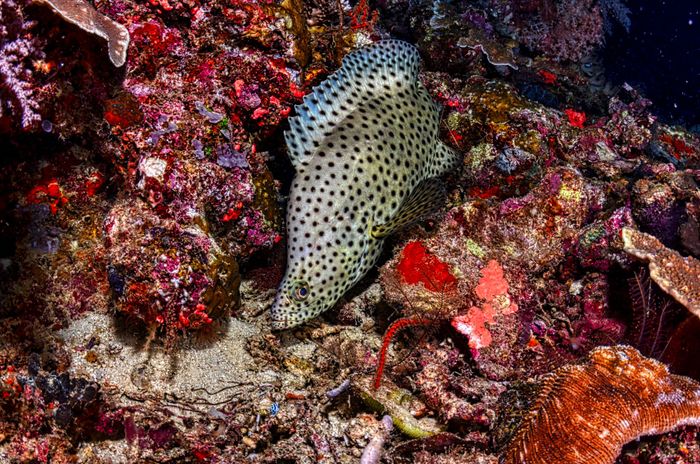
Close-up of a humpback grouper in a colorful coral reef in West Papua, Indonesia.
📷 Tom Fisk · Pexels

Eastern Fields — Jackson Reef

Advanced reef diving at Jackson Reef in Papua New Guinea's Eastern Fields. Steep walls and strong currents reward experienced divers year-round.

⭐ Best for advanced divers.

updated 4 months ago
Dificultad
Avanzado
Profundidad
5–40 m
AdvancedOnlyCurrentVariesBoatOnly

De un vistazo

Actividad
dive
Dificultad
advanced
Profundidad
5–40 m

Mapa

Este spot Aeropuerto Spots cercanos
© OpenStreetMap · CARTO
Abrir en Google Maps

Condiciones hoy

Condiciones

Open-Meteo
Viento
27.2 kn
Olas
3.72 m
Agua
25°C
N E S W
Wind direction (7d)
Primary: SE (66%)
Now: ESE (121°)
Marea (7 días)
amplitud: 1.85m

Próxima: Alta a las 05:00 (+0.65m)

+1.8 m0 m-0.1 m
▲ 05:00 · +0.65m ▼ 10:00 · +0.31m ▲ 18:00 · +1.38m ▼ 01:00 · +0.34m
Sáb 19Dom 20Lun 21Mar 22Mié 23Jue 24Vie 25
UV8.85 · very high Aire PM2.523 · moderate 06:09 18:13
Día Viento Olas UV Lluvia
09-19 28.3 3.74 9 1mm
09-20 24.1 3.38 9 0mm
09-21 20.8 2.44 8 0mm
09-22 20.9 2.1 9 0mm
09-23 21.6 2.12 9 0mm
09-24 21 2.14 9 0mm
09-25 22.7 2.4 9 0mm

About this spot

Jackson Reef sits in the Eastern Fields region of Papua New Guinea, a destination for advanced divers seeking technical wall dives and challenging currents. The reef drops from 5 meters at the shallows to 40 meters, with sections suitable for experienced divers comfortable with deeper exploration. The steep topography and open-water positioning mean this site rewards divers with strong buoyancy control and current management skills. The Eastern Fields region offers consistent diving throughout the year, though conditions vary seasonally. Jackson Reef attracts divers interested in Papua New Guinea's remote reef systems, away from heavily trafficked tourist zones. Access requires coordination with local operators familiar with PNG waters and logistics. This is not an entry-level site. Divers should have advanced training and experience on walls and in surge conditions before attempting Jackson Reef. The combination of depth, topography, and Pacific swell exposure demands solid technique and conservative planning. Three community videos document dives here, providing reference material for planning.

Tipos de buceo

ParedPelágico

Esenciales del viaje

Todo lo que necesitas antes de hacer la maleta — checklist, sol, logística.

Trip checklist

  • 🛂 Visa-free or visa-on-arrival
  • 📜 C-card + dive insurance (DAN)
  • 📔 Dive logbook
  • 🧴 Reef-safe sunscreen SPF 50+
  • 💊 Seasickness meds + ear drops
  • 📱 Offline maps + emergency contact

Quick facts

  • 🌓 Moon First quarter · 47%
  • GPS
Información de sostenibilidad
🌍 CO2 footprint MAD ↔ 15475km · ~3559kg · €64

Desde tu país de salida

Estados Unidos
Puntuación de origen: 65/100
  • Visado: Sin visado · 90 días máx.
  • Vuelo: 15h · directo
  • Jet-lag: 9h este · 6 días de recuperación

Preguntas frecuentes

When is the best time to dive Jackson Reef?

Jackson Reef can be dived year-round. Papua New Guinea's tropical climate means consistent water conditions, though seasonal swells and currents vary. Plan trips during dry season months (May–October) for generally calmer surface conditions and easier logistics.

What depth and skills do I need?

The reef ranges from 5 to 40 meters. This is an advanced site only—you need strong buoyancy control, current awareness, and experience on deep walls. Divers should log deep dives and have practiced in surge conditions before Jackson Reef.

What marine life will I see?

Papua New Guinea reefs host diverse fish, sharks, rays, and invertebrates typical of the Coral Triangle. Specific species observations for Jackson Reef are limited in public records, so check with local operators for current wildlife reports.

How do I get there and what permits do I need?

Jackson Reef is in the Eastern Fields, outside a marine protected area. Access is by boat from PNG ports; you'll need a valid passport and PNG entry visa. Coordinate with established dive operators in the region for logistics, permits, and safety briefings.

See this spot in action

YouTube videos — click to play.

SpearFishing Papua New Guinea - Eastern Fields Part 1

Sailing Catamaran Diving Adventures

Loloata Island Resort Dive Resort (Papua New Guinea)

cairnsdiver

Dawn dive

Drone KLM

Spots cercanos

Tufi — Stuart Reef Papua New Guinea Buceo
🇵🇬 Papua New Guinea

Tufi — Stuart Reef

Stuart Reef near Tufi offers advanced diving on pristine coral walls. Access remote Papua New Guinea reefs year-round.

Avanzado 15–35m
Osprey Reef — North Horn Australia Buceo
🇦🇺 Australia

Osprey Reef — North Horn

Osprey Reef's North Horn is an advanced dive site in Australia's Coral Sea Marine Park, dropping to 40m with strong currents and pelagic action.

Avanzado 8–40m

Similar spots

Same activity, shared marine species or similar profile.

Walindi — Bradford Shoals Papua New Guinea Buceo
🇵🇬 Papua New Guinea

Walindi — Bradford Shoals

Walindi's Bradford Shoals offers advanced divers dramatic deep coral formations and prolific pelagic action in Papua New Guinea's Kimbe Bay.

Avanzado 18–40m
Raja Ampat — Cape Kri Indonesia Buceo
🇮🇩 Indonesia

Raja Ampat — Cape Kri

Cape Kri in Raja Ampat delivers steep walls and strong currents packed with sharks, rays, and schooling fish. Advanced divers only.

Avanzado 8–40m
Lord Howe — Ball's Pyramid Australia Buceo
🇦🇺 Australia

Lord Howe — Ball's Pyramid

Ball's Pyramid offers advanced divers a chance to explore a volcanic pinnacle in the remote Lord Howe Island Group World Heritage Area.

Avanzado 15–40m
Tubbataha — Amos Rock (North Atoll) Philippines Buceo
🇵🇭 Philippines

Tubbataha — Amos Rock (North Atoll)

Amos Rock at Tubbataha's North Atoll is an advanced drift dive in the Philippines reaching 40m, within a protected marine park.

Avanzado 5–40m

Sugerir un operador

¿Conoces un buen centro de buceo, escuela de kite o guía local en este spot? Cuéntanos — lo revisamos y lo añadimos.

Hasta 500 caracteres
Planear
View →