
On 14 February 2024, the Copernicus OSTIA sea surface temperature pixel covering Santa Maria, Sal Island read 22.4 °C. That same morning, easyJet flight U28553 boarded at London Gatwick gate 47, destination SID, scheduled flight time 5 h 50 min, zero stops.[1] Almost every other warm-water diving destination British divers obsess over — Raja Ampat, the Maldives, Belize, the Similan Islands — required at least one connection that day, and most required two.
This piece does one thing: it crosses OpenFlights' scheduled non-stop route table against Copernicus monthly SST climatology to surface the actual list of dive destinations a London-based diver can reach without changing planes, where the water also clears 21 °C at a verified dive site within 200 km of the arrival airport. The 21 °C threshold is the lower comfort floor commonly cited for a 3 mm wetsuit; it is not a physiological limit, and many UK-trained divers happily work colder.[2]
The interesting result isn't the list of destinations that qualify. It's how short the list is, and how seasonally narrow even the qualifiers turn out to be once you look month by month.
✈️ The constraint that shrinks the list fast

- Route universe queried: non-stop scheduled services from LHR, LGW, STN, LCY, LTN to warm-latitude countries (OpenFlights routes.dat, accessed 2024)[3]
- Spot corpus: 2,928 verified OWA dive sites globally
- Proximity buffer: 200 km from arrival airport (a practical compromise, not a physical one)
- SST source: Copernicus Marine Service OSTIA, 1/20° resolution, monthly climatological mean 1993–2023[1]
- SST floor: 21 °C — the widely cited 3 mm wetsuit comfort threshold[2]
OpenFlights encodes "stops" as an integer; we filtered on stops = 0, which means zero intermediate airports — not zero aircraft changes (rare on leisure routes, but possible). The 200 km buffer is generous: a diver landing at Larnaca and driving to Paphos covers about 140 km, so the buffer captures real travel patterns without inflating the candidate set.
The result of the join was sobering. After filtering for ≥ 21 °C monthly mean SST at a verified spot within range, fewer than a dozen non-stop routes from London airports survived. Most of what UK dive media writes about — Thailand, Indonesia, the Philippines, the Maldives, the Bahamas, Fiji — does not appear, because none of those countries has a scheduled non-stop service from any London airport.
The biggest caveat sits in the route data itself. OpenFlights' route table is community-maintained and lags real-world schedules by weeks to months. Charter services (TUI seasonal flights from regional airports, ad-hoc winter operations to Hurghada) are systematically under-represented. This piece covers scheduled, publicly bookable services only.
🌊 Cape Verde — the only year-round qualifier

- Route: LGW → SID (Sal), ~5 h 40 min, easyJet / TUI / TAP[3]
- SST range: 22.1 °C (February) to 26.4 °C (September), Copernicus OSTIA 1993–2023[1]
- Nearest verified spot: Dive Tribe, Santa Maria — approximately 8 km from SID
- OBIS records within 50 km: loggerhead turtle (Caretta caretta), nurse shark (Ginglymostoma cirratum)[4]
- Threshold months above 21 °C: all twelve
Cape Verde is the only destination on the qualifying list where the Copernicus climatology shows no month dipping below 21 °C. February is the coldest month at 22.1 °C; September the warmest at 26.4 °C. No other destination reachable non-stop from London achieves this.
The reason is geographic. Sal sits at 16.7° N in the path of the Canary Current and the eastern Atlantic warm pool. The water never cools to Mediterranean winter levels because it never sees a continental winter. For a London diver wanting one trip in January or February at warm-water temperatures without a connection, this is essentially the only option in the dataset.
The trade-off is wind. From December through February, the harmattan-influenced north-east trades push surface chop frequently above 1.5 m on Sal's exposed coastline. SST is warm; boat-diving days get cancelled. Open-Meteo's historical wave model[5] shows median wave heights of 1.6–2.0 m at the Sal pixel in January, against 0.9–1.2 m in May. The 21 °C number is honest; it is not the only number that matters.
🐠 Egypt's Red Sea — winter warmth, one travel-advisory caveat
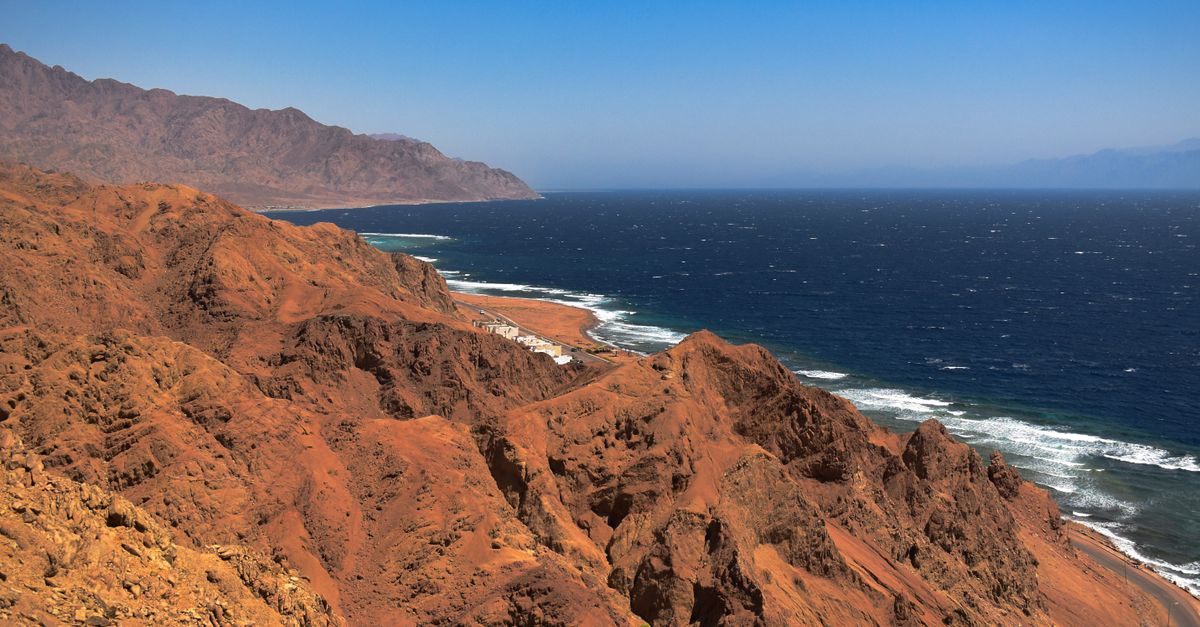
- Routes: LGW → SSH (~5 h 10 min) and LGW → HRG (~5 h 20 min), multiple carriers[3]
- SST (January): 22.3 °C at Sharm el-Sheikh pixel, NOAA OISSTv2.1[6]
- SST (August): 28.7 °C at the same pixel
- Operators in range of SSH: Free Dive Dahab, Menadive
- Threshold months above 21 °C: all twelve at Sharm; January marginal at Hurghada
The Red Sea is the only other destination on the list to clear 21 °C every month, and it does so by a wider margin than Cape Verde in summer. Sharm el-Sheikh's August mean of 28.7 °C is roughly Caribbean. January's 22.3 °C beats every Mediterranean destination on this list by at least three months.
The dive-site density is also higher than anywhere else within non-stop range. The Sinai cluster (Dahab, Sharm) and the mainland Hurghada/El Gouna cluster both sit inside the 200 km buffer of their respective airports, with verified OWA operators in both. OBIS records oceanic whitetip (Carcharhinus longimanus) occurrences at Brothers and Daedalus, though those require a liveaboard from Hurghada rather than a day-trip from SSH.[4]
One non-negotiable caveat: the UK Foreign, Commonwealth & Development Office maintains a travel advisory specific to the Sinai Peninsula that has shifted multiple times since 2023.[7] We do not editorialise on safety. We note that any diver booking SSH should read the current FCDO page directly. SST data is politically neutral; travel risk is not.
🏛️ Cyprus — the Mediterranean's longest warm window
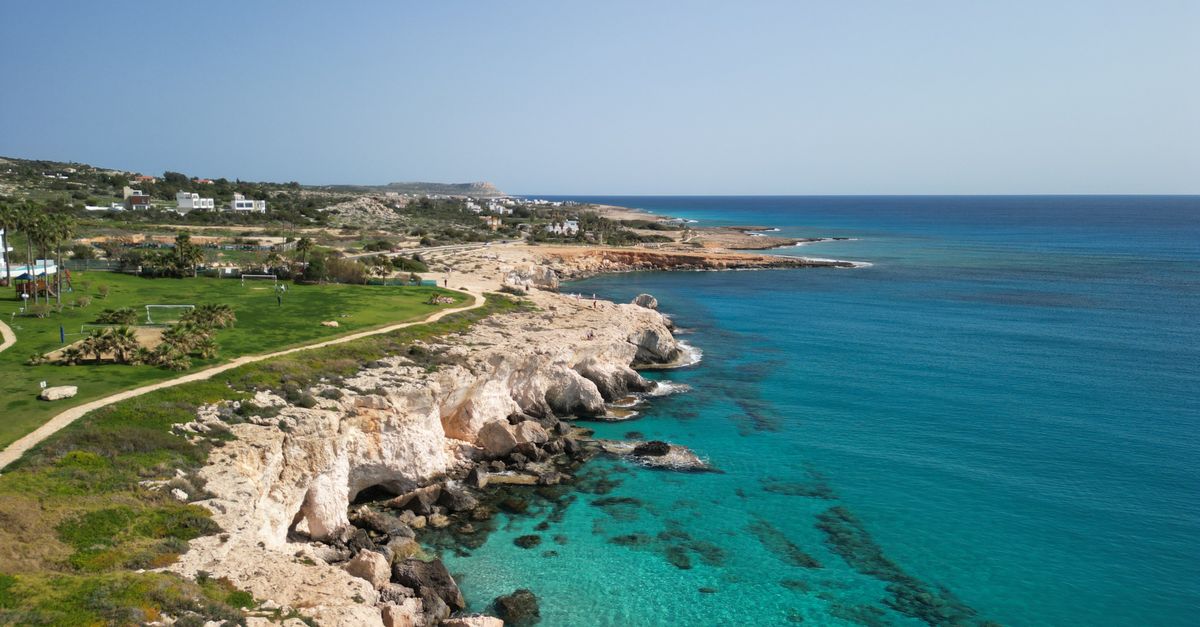
- Route: LHR → LCA (Larnaca), ~4 h 40 min, British Airways / Cyprus Airways; LGW → LCA on easyJet[3]
- SST window above 21 °C: approximately 20 April through early November[1]
- Peak SST: 28.1 °C in August (Copernicus, Larnaca coastal pixel)
- Operators in range: CyDive, I Dive Cyprus, Dive & Ski AquaNaut
- Threshold months: May, June, July, August, September, October (six clean months; April and November partial)
Cyprus has the longest above-threshold window of any Mediterranean destination reachable non-stop from London. The Copernicus pixel for the Larnaca coast crosses 21 °C around 20 April and drops back below in early November — a window of roughly six and a half months. No other Mediterranean island served non-stop from a London airport matches this.
The dive-site density also rewards the longer trip. Three independently verified OWA operators sit within the LCA buffer, covering different specialities (wreck work at the Zenobia, shore diving along the south coast, technical depth options on the Akrotiri side). The August peak of 28.1 °C is warm enough that 3 mm shorties become reasonable; the April shoulder still calls for a 5 mm.
The honest gap: summer thermocline compression at depth means surface SST of 28 °C does not translate to 28 °C at 30 m, and some sites report summer visibility dropping to 10–15 m as warm surface water traps suspended particulate. Our database holds no systematic visibility logging at individual sites — that is a known coverage gap.
🌊 Croatia's Adriatic — narrower than the Mediterranean reputation suggests
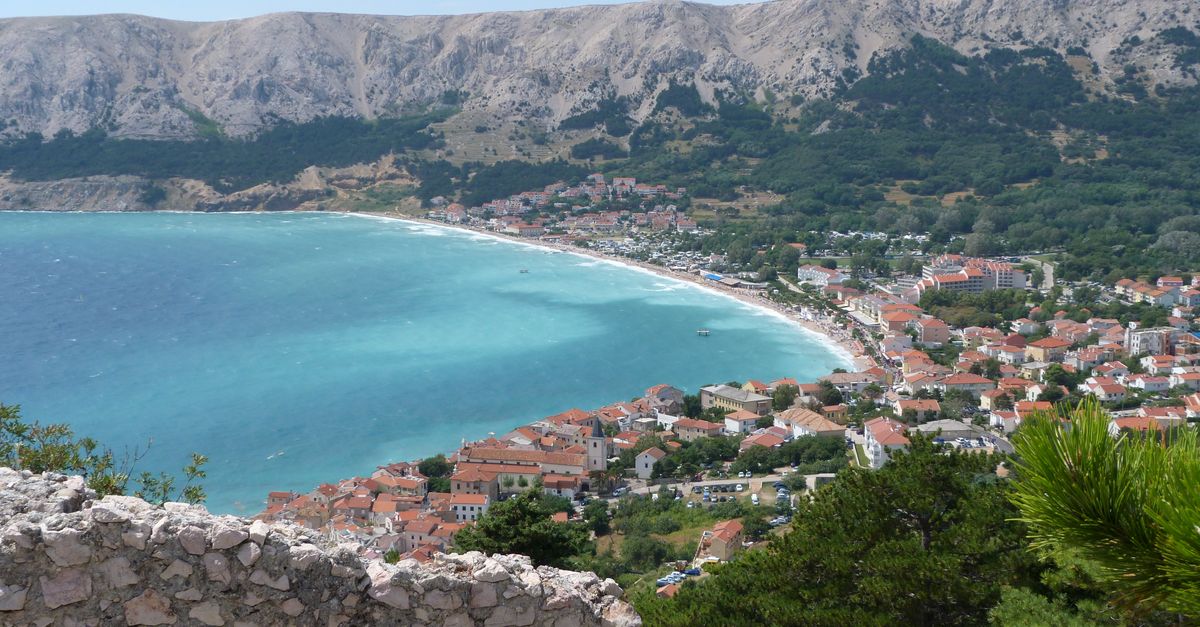
- Route: LGW → RJK (Rijeka/Krk), Ryanair, seasonal May–October only[3]
- SST above 21 °C: July, August, September only — three months
- January SST at Krk pixel: 13.0 °C (Copernicus)[1]
- Operators in range: Dive Loft Krk, Krnicadive on the Istrian peninsula
- Peak SST: 24.6 °C in August
Croatia is where the methodology corrects a common assumption. "The Mediterranean is warm" is a summer statement. The northern Adriatic at Krk's latitude (45° N) crosses 21 °C only in July, holds through August, and drops below the threshold in early October. By January the same pixel reads 13 °C — colder than the English Channel in late summer.
The route itself is also seasonal. Ryanair's LGW → RJK service operates from approximately May through October; there is no winter non-stop. The combination of a summer-only route and a summer-only SST window means Croatia is a July-through-September destination in this dataset — and nothing else.
The draw at Krk and Istria is wreck and wall diving in genuinely clear water, not megafauna. OBIS records inside the 200 km buffer are dominated by benthic invertebrates and small reef fish; the pelagic encounter rate is low.[4] Our biodiversity numbers count occurrence records, which is not the same as ranking dive quality.
🌺 Guadeloupe — the long-haul direct most London divers don't know about
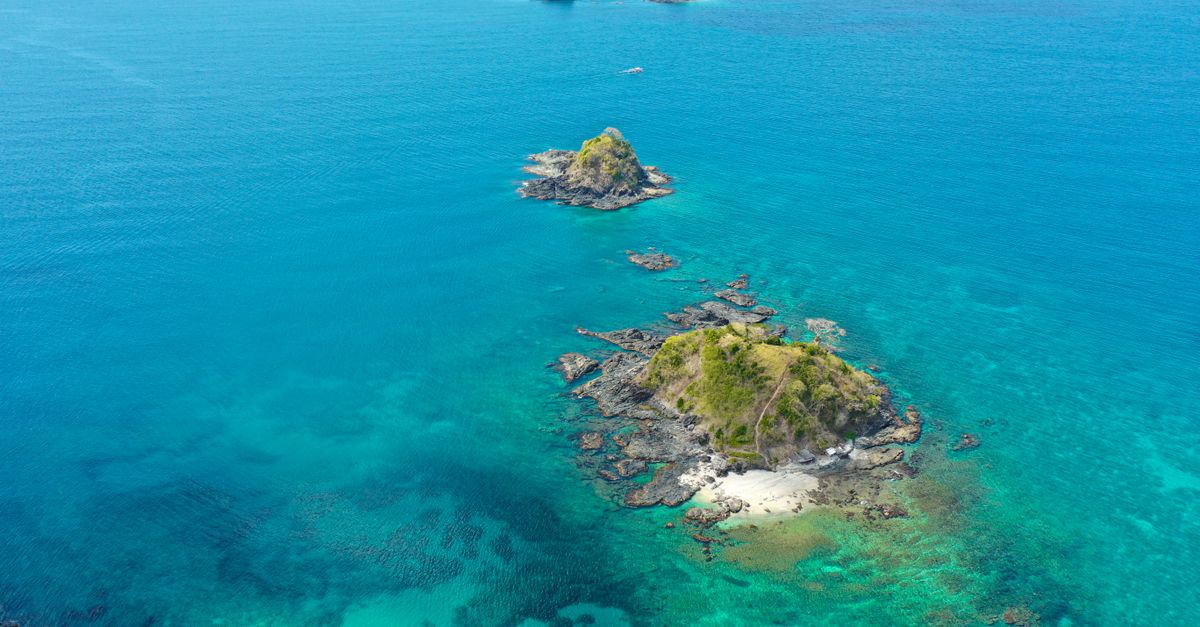
- Route: LHR → PTP (Pointe-à-Pitre), Air France, ~8 h 45 min, approximately three weekly[3]
- SST range: 26.2 °C (February) to 29.1 °C (September), Copernicus[1]
- Operator in range: Gwadive, Pigeon Island side
- Threshold months above 21 °C: all twelve, by a wide margin
- Carrier concentration: single carrier (Air France only)
Guadeloupe is a French overseas department, which is why it appears under "France" in our schema. The route is the only scheduled non-stop from a London airport to a destination with Caribbean SST values — every month above 26 °C — and it is systematically absent from UK dive travel coverage, which tends to default to Egypt or Cape Verde when listing warm-water options.
The catch is structural: it is a single-carrier route. Air France is the only operator on LHR → PTP, frequency is around three weekly, and the price premium over Sal or Sharm is significant. Schedule risk on a monopoly route is real; one operator's quarterly review can remove the only non-stop overnight.
Our coverage of Guadeloupe is thin. We hold one verified operator slug. The island has more dive infrastructure than that — Pigeon Island alone supports half a dozen schools — and the absence reflects our database, not the destination. If you know a Guadeloupe operator we should add, please write.
📊 The month-by-month matrix
| Destination (gateway) | J | F | M | A | M | J | J | A | S | O | N | D |
|---|---|---|---|---|---|---|---|---|---|---|---|---|
| Cape Verde (SID) | 22.4 ✓ | 22.1 ✓ | 22.3 ✓ | 22.9 ✓ | 23.6 ✓ | 24.5 ✓ | 25.4 ✓ | 26.0 ✓ | 26.4 ✓ | 26.1 ✓ | 24.9 ✓ | 23.5 ✓ |
| Egypt – Sharm (SSH) | 22.3 ✓ | 21.7 ✓ | 22.0 ✓ | 23.5 ✓ | 25.7 ✓ | 27.4 ✓ | 28.3 ✓ | 28.7 ✓ | 28.2 ✓ | 27.0 ✓ | 25.1 ✓ | 23.4 ✓ |
| Cyprus (LCA) | 17.8 — | 17.2 — | 17.6 — | 19.4 — | 22.0 ✓ | 25.4 ✓ | 27.6 ✓ | 28.1 ✓ | 27.3 ✓ | 24.9 ✓ | 21.8 ✓ | 19.4 — |
| Croatia – Krk (RJK) | 13.0 — | 12.4 — | 13.0 — | 15.2 — | 19.0 — | 22.7 ✓ | 24.4 ✓ | 24.6 ✓ | 22.7 ✓ | 19.4 — | 16.6 — | 14.2 — |
| Guadeloupe (PTP) | 26.4 ✓ | 26.2 ✓ | 26.4 ✓ | 26.9 ✓ | 27.7 ✓ | 28.3 ✓ | 28.4 ✓ | 28.7 ✓ | 29.1 ✓ | 28.9 ✓ | 28.2 ✓ | 27.2 ✓ |
Values are Copernicus OSTIA monthly climatological means, 1993–2023, in degrees Celsius, sampled at the coastal pixel nearest the named gateway.[1] The ✓/— flag marks the 21 °C threshold.
The 30-year standard deviation at most of these pixels sits between 0.6 °C and 1.5 °C, meaning any given year can run warmer or cooler than the mean by more than a degree.[8] The matrix is a planning tool, not a thermometer.
⚠️ What this list deliberately doesn't tell you
- Non-stop in the dataset ≠ non-stop year-round. OpenFlights records whether a route exists, not whether it operates every month. Croatia (RJK) is seasonal; some Egypt services run only during peak demand. Verify against current airline timetables before booking.
- SST at the airport ≠ SST at the dive site. The 200 km buffer is a compromise. Upwelling cells, river plumes, and enclosed bays can shift in-situ temperatures by 3–5 °C off the Copernicus open-ocean pixel. We hold no in-situ temperature logs at individual sites; the raster is a regional proxy.
- 21 °C is a cultural threshold, not a safety one. UK divers trained in 8–12 °C North Sea conditions routinely work in 18–20 °C water without complaint. This methodology excludes the Canary Islands in winter (~19–20 °C), which many London-based divers would book happily. The floor is for consistency, not because colder is undiveable.