
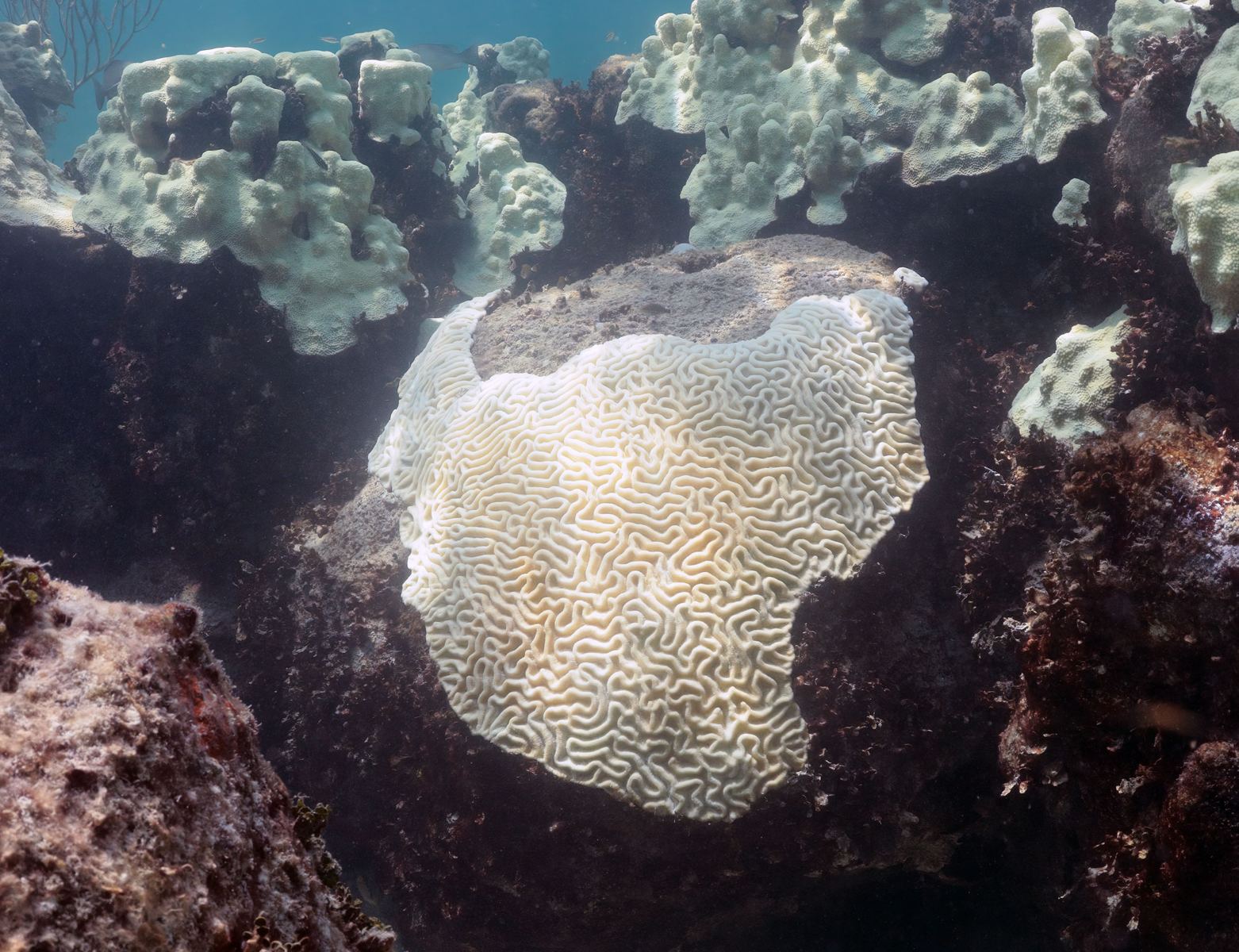
On 16 November 2026, 565 of the 1,383 reef dive sites we track — 41% — were under coral heat stress. 235 of them had accumulated enough heat for bleaching to be likely, and 99 were at the level where coral death is expected. When we first ran this analysis in May, the same headline numbers were 35%, 81 and 43.
These are not model projections. Every figure comes from NOAA Coral Reef Watch satellite data[1], matched to the exact coordinates of each dive site in the OpenWaterAtlas database and refreshed every day on our live coral heat-stress tracker.
Where it is worst right now
Heat stress is measured in Degree Heating Weeks (DHW): how much, and for how long, the water has been hotter than the warmest normal month over the past 12 weeks. At DHW 4 significant bleaching is likely; at DHW 8 severe bleaching and widespread coral mortality are likely[1].
| Destination | Tracked dive sites | Mean DHW | Sites at DHW ≥ 8 |
|---|---|---|---|
| Ecuador | 9 | 13.6 | 9 |
| Dominican Republic | 7 | 11.8 | 7 |
| Spain | 10 | 11.0 | 10 |
| Colombia | 68 | 10.4 | 30 |
| Costa Rica | 10 | 10.0 | 8 |
| Mexico | 38 | 8.7 | 6 |
| Belize | 9 | 7.8 | 3 |
| Cayman Islands | 7 | 6.2 | 0 |
Countries with at least five tracked reef dive sites. Data as of 16 November 2026.
The pattern is regional: the Caribbean and the eastern tropical Pacific are carrying the heat. Every tracked site in Ecuador, the Dominican Republic and Spain sits above DHW 8. In Mexico, all 38 sites are above DHW 4, and Cabo Pulmo — the Baja California marine park famous for its fish recovery — reads DHW 17.6, more than double the mortality threshold.
The Red Sea is under milder but very widespread stress: 211 of Egypt's 235 tracked sites are above DHW 1, 48 of them above DHW 4. Elphinstone Reef reads DHW 8.4.
What changed since May
Some of the rise is the calendar. Heat stress peaks at the end of each hemisphere's summer, so a May reading (end of the southern summer) and a November reading (end of the northern summer) see different oceans at their hottest. That is why the Caribbean, Mexico and the Red Sea went from near zero in May to where they are now.
But the size of the swing is the story. On the same sites, mean DHW went from 0.0 to 8.8 in Mexico, 0.0 to 11.8 in the Dominican Republic and 3.5 to 10.4 in Colombia, where every one of 68 sites is now under stress. Those are not normal late-summer readings; DHW 8+ means the water stayed far too hot for weeks.
The Indo-Pacific is quiet at the moment. The Maldives, Thailand, Australia, Fiji and French Polynesia all read DHW 0, and Indonesia averages 0.5. That is good news for divers heading there this winter, but their stress season is still ahead: it usually builds from February to May.
Does a bleached coral die?
Not necessarily. Bleaching means the coral has expelled the microscopic algae that live in its tissue and give it both its colour and most of its food. The animal is still alive. If the water cools within a few weeks, corals can take the algae back up and regain their colour over the following months.
If the heat lasts, the starving colonies die, their skeletons are overgrown by algae and slowly break apart. That is what DHW 8 signals. A reef can come back from that through new coral larvae settling and growing, but rebuilding coral cover takes a decade or more even for fast-growing species, and much longer for massive corals that are centuries old.
The problem is frequency. A study of 100 reef locations found that the median time between severe bleaching events has shrunk to about 6 years[4], too short for mature reefs to recover in between.
The bigger picture
Our numbers sit inside the most intense global bleaching episode ever recorded. Between January 2023 and September 2025, bleaching-level heat stress hit about 84% of the world's coral reef area, with mass bleaching documented in at least 83 countries and territories[2]. The previous record, set in 2014–2017, was 68%. NOAA now considers that fourth global event to have likely ended in mid-2025[2] — yet, as our November data shows, severe regional heat is still hitting reefs.
On the Great Barrier Reef, the Australian Institute of Marine Science recorded the largest annual drop in coral cover in its southern region on record in 2025, about 30%, while the northern region fell from 39.8% to 30% cover[3].
What this means if you dive
- Plan with the season in mind. If you want healthy-looking reefs this winter, the Indo-Pacific currently shows no heat stress. Check our best time to dive calendar alongside the coral tracker before you book.
- Diving a bleached reef is still worth it — and it matters. Operators and marine parks depend on dive tourism to fund protection. Keep your fins off the reef, don't touch or kneel on coral, and choose operators who brief on buoyancy.
- Report what you see. Citizen-science programmes such as Reef Check and CoralWatch use diver reports to map bleaching on the ground, which satellites cannot see.
- Check before you go. Every tropical dive site page on OpenWaterAtlas flags a current NOAA bleaching alert when the site is under heat stress.
Method and data
Each tropical dive site (within 35° of the equator) is matched to its nearest NOAA Coral Reef Watch 5 km grid cell. We read the daily Bleaching Alert Area and Degree Heating Weeks values and refresh them every day; 1,383 sites returned data on 16 November 2026. Country figures include only destinations with at least five tracked reef dive sites. The site-level data is part of our open dataset under CC-BY 4.0[5], so you can reproduce or extend this analysis.
The live numbers, updated daily, are on the coral heat-stress tracker.